You installed solar panels, the system is running, the inverter reports daily production. Everything seems fine. But if you have not cleaned the panels since installation, there is a strong likelihood you are silently losing 5–25% of the energy you should be producing — with no alarm, no visible fault, no warning.
Soiling does not look dramatic. It builds gradually — dust, pollen, bird droppings, industrial particles. Each thin layer blocks a little light. Over time, the loss compounds.
How Much Does Soiling Actually Cost You?
According to IEA data and research published in 2025–2026:
- Typical annual soiling losses: 3–7% of total production under normal conditions
- In areas with dust, high pollen, or heavy traffic: 10–25% of production
- In extreme environments (construction sites, agricultural areas, windy dusty zones): up to 50% during periods without rain
For an 8 kWp residential system producing approximately 9,000 kWh per year:
- A 7% loss means 630 kWh per year not produced
- At €0.29/kWh (EU average): ~€183 lost annually
- Over 10 years: ~€1,830 — money left on the table because of uncleaned panels
⚡ Why rain is not enough
Many panel owners assume rain cleans their panels. Rain partially washes away loose dust, but does not fully remove it. Bird droppings, dried pollen, oily industrial particles, and calcium deposits from rainwater itself require mechanical cleaning to be removed effectively. After rain, a thin layer of dried mud often remains on the glass surface — reducing light transmittance and continuing to reduce output.
What Types of Soiling Affect Solar Panels
Dust and fine particles — settle uniformly across the surface, reduce light transmittance, partially washed by rain but quickly reaccumulate in areas with traffic or wind.
Pollen — seasonal (spring), sticks to the wet surface and forms a yellowish layer difficult to remove without mechanical cleaning.
Bird droppings — the most damaging type of soiling. Concentrated on a small area, they completely block the affected cells and can cause a partial shading effect that reduces output across the entire string, not just the covered cells. Acidic droppings can also attack the anti-reflective coating on the glass if left for extended periods.
Leaves and organic matter — settle in corners and along edges, retain moisture, and can accelerate frame corrosion if not removed.
Industrial deposits and soot — near busy roads, factories, or industrial areas, oily particles adhere to the surface and are not washed off by rain.
How Often Should Panels Be Cleaned?
There is no universal frequency — it depends on the location and environment of the installation.
| Installation type | Recommended frequency |
|---|---|
| Urban or suburban, tilted roof | Once a year — spring, after pollen season |
| Rural area, open field | Twice a year — spring and autumn |
| Agricultural area, construction site, busy road | 3–4 times per year |
| Industrial solar park (ground-mounted) | Based on performance monitoring — typically monthly or quarterly |
The best indicator is not the calendar — it is production monitoring. If your system is producing visibly less than the same period last year under similar weather conditions, soiling is one of the first things to check.
What Cleaning Methods Are Available
Manual cleaning with water and soft-bristle brush
The most common method for residential systems. Use clean water — preferably deionised or low-calcium — and a soft-bristle brush on a telescopic pole. Does not require roof access in most cases.
Important: Do not use aggressive detergents, solvents, or high-pressure washers. A 2026 Fraunhofer CSP study tested 5 commercially available solar panel cleaning products and found that 3 out of 5 caused permanent efficiency losses of up to 5.6% by attacking the anti-reflective coating on the glass. Clean water and a soft brush are sufficient in most cases.
Professional cleaning
Specialist teams with deionised water and water-fed pole systems. Recommended for larger systems, steeply pitched roofs, or where manual access is difficult. Documented professional cleaning is also important for manufacturer warranty — some manufacturers (Canadian Solar, Trina) require evidence of periodic maintenance to validate performance claims.
Robotic cleaning — the solution for solar parks
For industrial installations and large-scale solar parks, manual cleaning is not feasible — the surface areas are too large and the required frequency too high to cover with human teams.
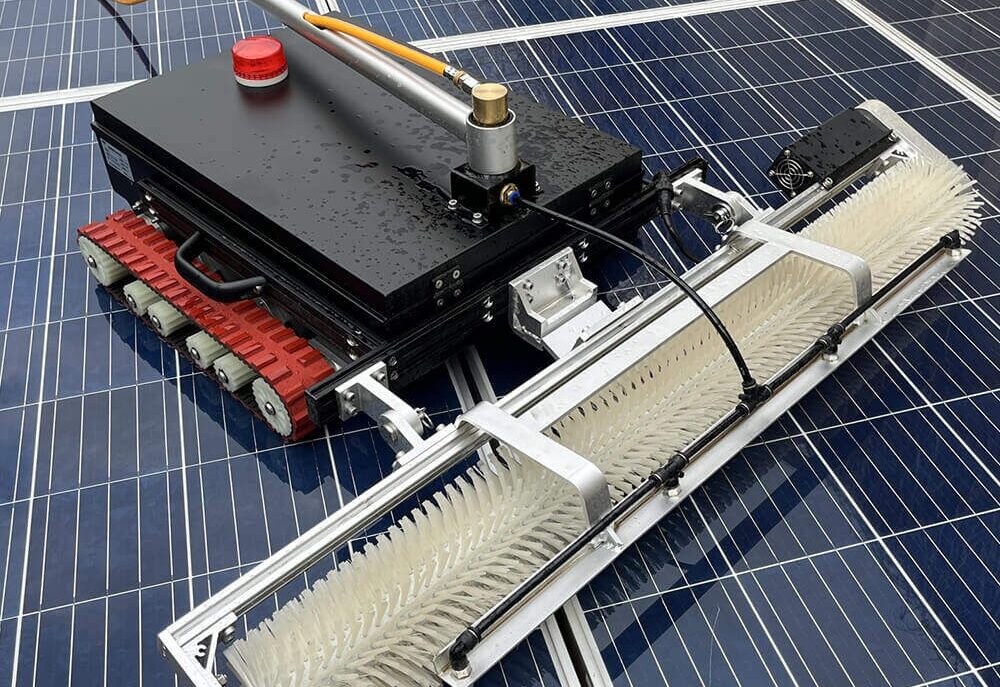
We operate a specialised robot for photovoltaic panel cleaning — an automated system that travels along panel rows and cleans them efficiently, with zero or minimal water consumption, without damaging panel surfaces.
According to research published in ScienceDirect (2025), robotic cleaning can recover 95–98% of efficiency lost to soiling, with an energy consumption of just 0.5–2% of the plant's output. Compared to manual cleaning, the robot delivers:
- Higher frequency — can clean more often, keeping losses to a minimum
- Consistency — the same results on every pass, without human variability
- Safety — eliminates the risk of injury associated with working at height
- Lower long-term operational cost for large installations
- Automatic documentation — some systems log the date, time, and results of each cleaning pass
If you have a solar park and want to know more about our robotic cleaning solution, contact us directly.
What NOT to Do When Cleaning Panels
Do not step on panels. Even at the frame edge, the weight of a person can create microcracks in silicon cells — invisible to the naked eye, but degrading output over years.
Do not use cold water on hot panels. Thermal shock can crack the glass or cells. Clean early in the morning or in the evening, when panels have cooled.
Do not use unapproved chemical products. As noted, the 2026 Fraunhofer CSP study demonstrated that the wrong cleaning chemicals can cause permanent efficiency losses and void the manufacturer's warranty.
Do not use high-pressure washers. High-pressure water jets can penetrate the gaps between glass and frame, damaging seals and allowing moisture ingress.
Panel Cleaning and Manufacturer Warranty
This is something many panel owners are not aware of: neglecting cleaning can affect your warranty.
Most solar panel manufacturers include periodic maintenance requirements — including cleaning — in their warranty terms. If you make a performance claim and the manufacturer finds the panels were not maintained, they can reject the claim.
Keep a simple record of cleanings: date, method used, who performed the cleaning. If you use a specialist company or our robotic cleaning service, you will automatically receive the documentation needed.
Summary: What You Need to Remember
Cleaning solar panels is not optional — it is part of normal system maintenance, just like an oil change for a car. Dirty panels silently lose 5–25% of production, with no alarms and no visible faults.
For residential systems, one cleaning per year — or twice a year in dustier areas — is sufficient in most cases. Use clean water and a soft brush — no aggressive chemicals, no high pressure.
For solar parks and industrial installations, robotic cleaning is the solution that delivers the frequency and consistency needed at a reasonable long-term operational cost.